Study · updated 25 November 2026
61 million Americans live where the statewide electrical code for houses is from 2017 or older, or there is none
We matched the National Electrical Code edition each state enforces for one- and two-family houses with the US Census Bureau’s 2025 population estimates. 60.9 million people, 17.8 % of the country, live in a state whose statewide code for houses is NEC 2017 or older, or where there is no statewide code at all. Only 15.7 % live under the newest edition, NEC 2026.
The statewide edition is a floor, not the whole story: many cities and counties adopt a newer one. A house is built to the code in force where and when its permit was issued. See limitations.
The numbers
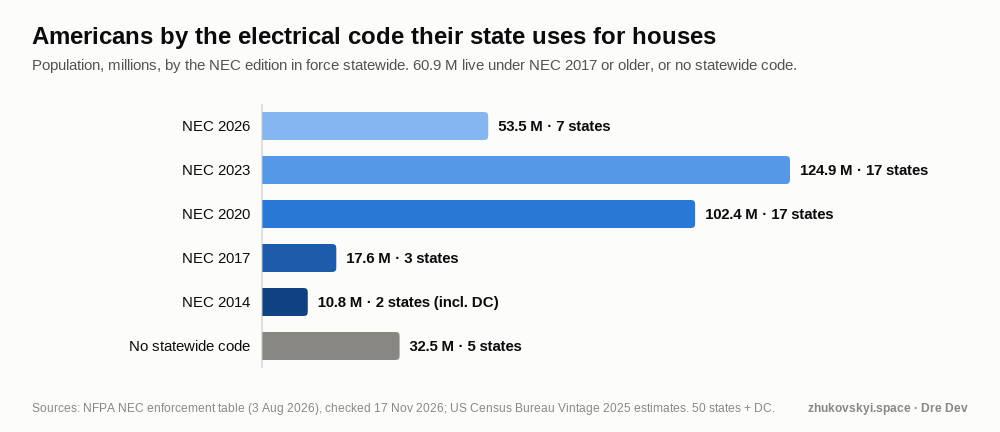
| Statewide edition for houses | States | Population, 2025 | Share |
|---|---|---|---|
| NEC 2026 | 7 | 53.5 M | 15.7 % |
| NEC 2023 | 17 | 124.9 M | 36.5 % |
| NEC 2020 | 17 | 102.4 M | 30.0 % |
| NEC 2017 | 3 | 17.6 M | 5.1 % |
| NEC 2014 | 2 | 10.8 M | 3.2 % |
| No statewide code | 5 | 32.5 M | 9.5 % |
| Total | 51 | 341.8 M | 100 % |
The 51 rows are the 50 states and the District of Columbia; DC is counted as a state here. Puerto Rico is left out: we could not confirm its edition from an official source.
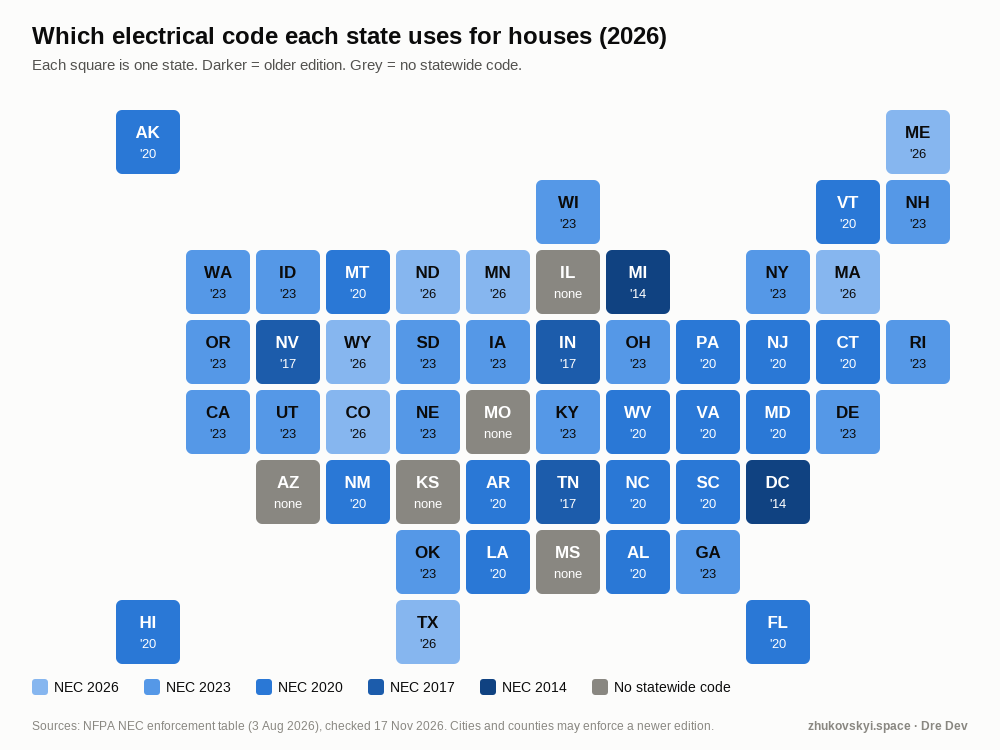
The states furthest behind
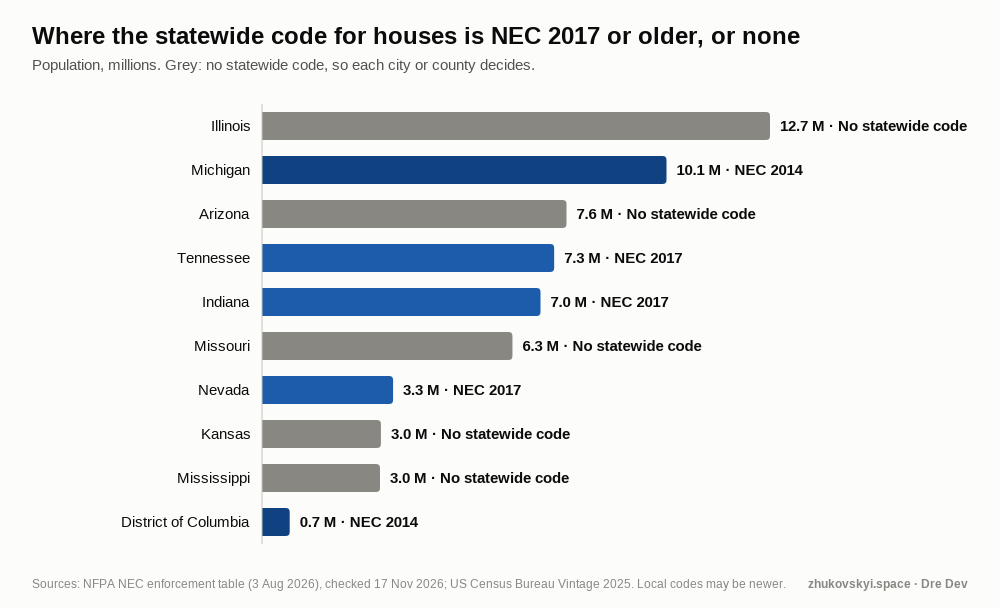
- Illinois (12,719,141 people): No statewide code. The state rule (NEC 2008) covers only commercial work outside cities with their own code. Chicago uses NEC 2017 with its own amendments.
- Michigan (10,127,884 people): NEC 2014, since 8 Feb 2016. One- and two-family houses. Commercial work: NEC 2023.
- Arizona (7,623,818 people): No statewide code. No statewide code: cities and counties adopt the NEC.
- Tennessee (7,315,076 people): NEC 2017, since 1 Oct 2018.
- Indiana (6,973,333 people): NEC 2017, since 26 Dec 2019. Houses: NEC 2017 through the 2018 IRC. NEC 2023 is being adopted.
- Missouri (6,270,541 people): No statewide code. No statewide code: cities and counties adopt the NEC.
- Nevada (3,282,188 people): NEC 2017, since 1 Jul 2018. The state rule covers state work; cities and counties usually adopt a newer NEC.
- Kansas (2,977,220 people): No statewide code. The State Fire Marshal rule is NEC 2008; cities and counties adopt their own.
- Mississippi (2,954,160 people): No statewide code. No statewide code: cities and counties adopt the NEC.
- District of Columbia (693,645 people): NEC 2014, since 29 May 2020. Through the 2017 DC Construction Codes; an update is in rulemaking.
What an older code can leave out
The NEC is revised every three years. Each edition adds protections that the earlier ones did not require. A house wired under an older edition is not unsafe by default, and many owners add these protections anyway; but the code does not ask for them. Below are protections for homes that each newer edition added, with the section and a source.
Added in NEC 2017
- 210.8(E): Lighting outlets in crawl spaces must be GFCI-protected. [source]
- 210.11(C)(4): A garage gets at least one dedicated 20-amp, 120-volt receptacle circuit. [source] [source]
Added in NEC 2020
- 230.67: Every dwelling service needs a whole-home surge protective device, also when the service equipment is replaced. [source]
- 230.85: One- and two-family houses need an emergency disconnect outdoors that firefighters can reach. [source]
- 210.8(A): GFCI protection in the listed dwelling locations covers 125–250-volt receptacles, so dryer and range receptacles there are included. [source]
- 210.8(A)(5): GFCI protection for receptacles in all basements, finished or not. [source]
- 210.8(F): Outdoor outlets up to 50 amps need GFCI protection, which brings in outdoor air-conditioning and heat-pump units. [source]
Added in NEC 2023
- 210.8(A): GFCI protection for all kitchen receptacles of 125–250 volts, not only the countertop ones, so the range receptacle is included. [source]
- 210.8(D): GFCI protection for appliances such as dryers, ranges and microwaves up to 150 volts to ground. [source]
- 230.67: The whole-home surge protective device must be rated at least 10 kA. [source]
- 210.8(F): Outdoor GFCI protection extends to outlets in garages, accessory buildings and boathouses. [source]
Added in NEC 2026
- 230.70(A)(1): The service disconnect for one- and two-family houses must be outdoors (or within sight and no more than 50 ft away) and marked as the emergency disconnect. [source]
- 210.8(F): Outdoor GFCI protection covers circuits up to 60 amps, and new outdoor HVAC units are no longer exempt. [source]
- 300.4(C): Wiring damaged by fire or water must be replaced. [source]
Why it matters
- In 2023, US fire departments responded to an estimated 23,700 residential building fires caused by electrical malfunction, with 305 deaths, 800 injuries and $1.5 billion in losses (US Fire Administration). [source]
Methodology
- Code edition. For each state and DC we took the NEC edition in force statewide for one- and two-family houses from NFPA’s NEC enforcement table (NFPA dates it 3 August 2026), as listed on our NEC edition by state page, checked 17 November 2026. Where a state uses one edition for houses and another for commercial work (Michigan, Indiana), we used the one for houses.
- No statewide code. Arizona, Illinois, Kansas, Mississippi and Missouri have no statewide edition that covers houses; cities and counties choose. We count them as a separate group, not as “old”.
- Population. US Census Bureau, Vintage 2025 estimates for 1 July 2025 (NST-EST2025-ALLDATA), downloaded 25 November 2026. The 51 figures add up to the US total of 341,784,857.
- “Editions behind” = (2026 − edition) ÷ 3, because the NEC is published every three years.
- Safety changes. Taken from NFPA and trade-press summaries of each edition, linked next to each item. We list only requirements for dwellings, and we do not quote the code text.
Limitations
- Local codes. In states with an old or no statewide code, large cities and counties often enforce a newer edition (Chicago uses NEC 2017 with its own amendments; New York City uses NEC 2020 while New York State uses NEC 2023). The numbers describe the statewide baseline, not every address.
- Nevada’s state rule covers state work; cities and counties usually adopt a newer NEC. North Carolina: NFPA lists NEC 2020 for buildings other than one- and two-family houses.
- Existing houses are built to the code in force when they were permitted; adopting a new edition does not change existing wiring.
- Population, not houses. We count people, not dwellings or new construction.
- Code adoption changes during the year. This page was checked on 25 November 2026; the CSV carries the same date.
All 50 states and DC
Download the data (CSV). Free to reuse with a link to this page (CC BY 4.0).
| State | Edition for houses | In force since | Editions behind | Population, 2025 | Note |
|---|---|---|---|---|---|
| Arizona | No statewide code | — | — | 7,623,818 | No statewide code: cities and counties adopt the NEC. |
| Illinois | No statewide code | — | — | 12,719,141 | The state rule (NEC 2008) covers only commercial work outside cities with their own code. Chicago uses NEC 2017 with its own amendments. |
| Kansas | No statewide code | — | — | 2,977,220 | The State Fire Marshal rule is NEC 2008; cities and counties adopt their own. |
| Mississippi | No statewide code | — | — | 2,954,160 | No statewide code: cities and counties adopt the NEC. |
| Missouri | No statewide code | — | — | 6,270,541 | No statewide code: cities and counties adopt the NEC. |
| District of Columbia | NEC 2014 | 29 May 2020 | 4 | 693,645 | Through the 2017 DC Construction Codes; an update is in rulemaking. |
| Michigan | NEC 2014 | 8 Feb 2016 | 4 | 10,127,884 | One- and two-family houses. Commercial work: NEC 2023. |
| Indiana | NEC 2017 | 26 Dec 2019 | 3 | 6,973,333 | Houses: NEC 2017 through the 2018 IRC. NEC 2023 is being adopted. |
| Nevada | NEC 2017 | 1 Jul 2018 | 3 | 3,282,188 | The state rule covers state work; cities and counties usually adopt a newer NEC. |
| Tennessee | NEC 2017 | 1 Oct 2018 | 3 | 7,315,076 | |
| Alabama | NEC 2020 | 1 Jul 2022 | 2 | 5,193,088 | |
| Alaska | NEC 2020 | 16 Apr 2020 | 2 | 737,270 | |
| Arkansas | NEC 2020 | 1 Aug 2022 | 2 | 3,114,791 | NEC 2026 is being adopted. |
| Connecticut | NEC 2020 | 1 Oct 2022 | 2 | 3,688,496 | NEC 2023 is being adopted. |
| Florida | NEC 2020 | 31 Dec 2023 | 2 | 23,462,518 | NEC 2023 is being adopted. |
| Hawaii | NEC 2020 | 14 Mar 2023 | 2 | 1,432,820 | |
| Louisiana | NEC 2020 | 1 Jan 2023 | 2 | 4,618,189 | |
| Maryland | NEC 2020 | 1 Jul 2025 | 2 | 6,265,347 | NEC 2023 is being adopted. |
| Montana | NEC 2020 | 10 Jun 2022 | 2 | 1,144,694 | NEC 2023 was expected from September 2026. |
| New Jersey | NEC 2020 | 6 Sep 2022 | 2 | 9,548,215 | |
| New Mexico | NEC 2020 | 28 Mar 2023 | 2 | 2,125,498 | |
| North Carolina | NEC 2020 | 1 Nov 2021 | 2 | 11,197,968 | NFPA lists this edition for other than one- and two-family dwellings. |
| Pennsylvania | NEC 2020 | 1 Jan 2026 | 2 | 13,059,432 | |
| South Carolina | NEC 2020 | 1 Jan 2023 | 2 | 5,570,274 | NEC 2023 from 1 Jan 2027. |
| Vermont | NEC 2020 | 1 Jan 2023 | 2 | 644,663 | NEC 2023 is being adopted. |
| Virginia | NEC 2020 | 18 Jan 2024 | 2 | 8,880,107 | NEC 2023 is being adopted. |
| West Virginia | NEC 2020 | 1 Aug 2022 | 2 | 1,766,147 | |
| California | NEC 2023 | 1 Jan 2026 | 1 | 39,355,309 | As the 2025 California Electrical Code. |
| Delaware | NEC 2023 | 1 Jan 2026 | 1 | 1,059,952 | |
| Georgia | NEC 2023 | 1 Jan 2025 | 1 | 11,302,748 | |
| Idaho | NEC 2023 | 1 Jul 2023 | 1 | 2,029,733 | |
| Iowa | NEC 2023 | 1 Jul 2025 | 1 | 3,238,387 | NEC 2026 is being adopted. |
| Kentucky | NEC 2023 | 1 Jan 2025 | 1 | 4,606,864 | NEC 2026 is being adopted. |
| Nebraska | NEC 2023 | 1 Aug 2024 | 1 | 2,018,006 | NEC 2026 is being adopted. |
| New Hampshire | NEC 2023 | 1 Jul 2025 | 1 | 1,415,342 | |
| New York | NEC 2023 | 31 Dec 2025 | 1 | 20,002,427 | New York City: NEC 2020 with city amendments. |
| Ohio | NEC 2023 | 15 Apr 2024 | 1 | 11,900,510 | |
| Oklahoma | NEC 2023 | 14 Sep 2024 | 1 | 4,123,288 | |
| Oregon | NEC 2023 | 1 Oct 2023 | 1 | 4,273,586 | NEC 2026 was expected from 1 Oct 2026. |
| Rhode Island | NEC 2023 | 1 Dec 2025 | 1 | 1,114,521 | |
| South Dakota | NEC 2023 | 12 Nov 2024 | 1 | 935,094 | |
| Utah | NEC 2023 | 1 Jan 2025 | 1 | 3,538,904 | |
| Washington | NEC 2023 | 1 Apr 2024 | 1 | 8,001,020 | NEC 2026 is expected from 31 Dec 2026. |
| Wisconsin | NEC 2023 | 1 Sep 2026 | 1 | 5,972,787 | Before 1 Sep 2026: NEC 2017. |
| Colorado | NEC 2026 | 1 Aug 2026 | 0 | 6,012,561 | |
| Maine | NEC 2026 | 1 Jul 2026 | 0 | 1,414,874 | |
| Massachusetts | NEC 2026 | 24 Apr 2026 | 0 | 7,154,084 | |
| Minnesota | NEC 2026 | 17 Aug 2026 | 0 | 5,830,405 | |
| North Dakota | NEC 2026 | 1 Jul 2026 | 0 | 799,358 | |
| Texas | NEC 2026 | 1 Sep 2026 | 0 | 31,709,821 | |
| Wyoming | NEC 2026 | 1 Jul 2026 | 0 | 588,753 |
Cite and contact
Cite as: Andrii Zhukovskyi (Dre Dev), “61 million Americans live where the statewide electrical code for houses is from 2017 or older, or there is none”, zhukovskyi.space, 25 November 2026. Charts may be reused with that credit. Questions, a state’s data or a comment: [email protected]. More on the author: about, press kit.
This is a summary of public data, not legal or electrical advice. Electrical work needs a permit and an inspection; ask your local building department which code applies to your address.